I had the honor to serve as one of four delegates of The Episcopal Church to the United Nations Commission on the Status of Women 70 at U.N. headquarters in New York. This is the eighth time that I have attended in one role or another, and although each session has had important takeaways, this session had critical areas of concern which can be positively impacted at the grass roots level.
This session is made even more important because The Episcopal Church is making a serious commitment to bringing resources to the diocesan and parish level. The work for the kingdom does not start in some faraway place, but right here, in our neighborhoods.
This year’s theme is Ensuring and Strengthening Access to Justice for All Women and Girls (More information about the theme can be found at the link above). Primarily the commission explored how access to justice, free from violent repercussions, can be provided to women and girls, with a broad definition of gender. The Agreed Conclusions or Outcomes Document (available here), provide a series of remedies so that women can safely receive access to court, as well as access to the social support services that go along with many of the reasons that women seek redress. It is an exhaustive document which shows many months of work to achieve major consensus, providing much need protections and support.
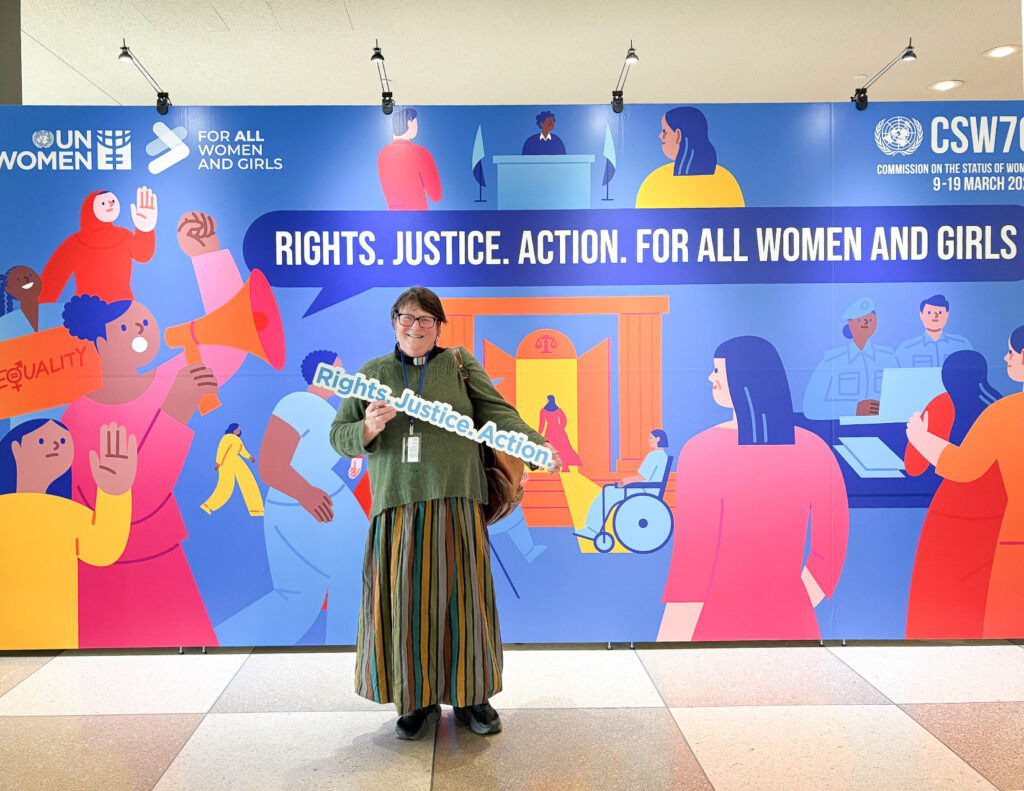
My primary concerns about the document are for those of us in the United States. The US was the only country to vote against the conclusions, and their reasons were tied to three key issues – a broad and inclusive definition of gender, healthcare autonomy for women and girls, and diversity, equity, and inclusion language. The US was opposed to the language in the document which supported these things.
For those of us who agree with the Outcomes Document on these issues, how do we ensure that our voices are heard? While I was at the UN, I decided to go to the source, and I asked the Team Leader at United Nations Mediation Support Unit how my voice could be heard at the peace table and for justice. He told me to think about Track Two diplomacy and see in what ways it has been effective in the US in the past, particularly when formal diplomacy between nation states stalls. Track Two diplomacy is the work of a variety of leaders in communities who can take diplomacy to places official diplomats cannot. When done well, Track Two diplomacy can decrease misinformation and increase communication.
While I learned many things at UNCSW70, the most life-changing lesson that I bring to you is that each of you reading this article – canons, priests, deacons, lay leaders – each of you has a place in Track Two diplomacy. Grass roots efforts that seek to increase communication, dispel misinformation, and proclaim the dignity and beauty of the image of God in every person are effective. By working in our congregations, neighborhoods, cities or towns, and states we can affect change. We can begin by taking steps to learn more about using Track Two diplomacy effectively and then can to take it to the streets. I am starting by teaching myself more about Track Two diplomacy and then modeling my priesthood on the example set by Presiding Bishop Sean Rowe, when he said, “At its best, our church is capable of moral clarity and resolute commitment to justice. I believe we can bring those strengths to bear on this gathering storm. Churches like ours, protected by the First Amendment and practiced in galvanizing people of goodwill, may be some of the last institutions capable of resisting the injustice now being promulgated. That is not a role we sought—but it is one we are called to.”[1]In solidarity, we can work to have our dreams heard. It will be challenging work, because the work of the Gospel is never easy, but it is work that, when done in community, can bring us joy and hope in a time that can easily lead to despair.
by the Rev. Jenn Allen
(The opinions expressed in this piece are solely those of the author. They are not reflective of the opinions of The Episcopal Church.)
[1] Rowe, Sean, “Acting faithfully in troubling times: A letter from Presiding Bishop Rowe,” June 11, 2025, by email
 835 SW Polk St.