From Emporia to Florence, Kansas, Highway 50 glides across mile after mile of tallgrass prairie, offering endless vistas of the Kansas horizon. One of the most notable features of this region is the prairie grass itself. Although prairie grass can grow to six or seven feet tall, the real glory occurs below the sod, in the hidden and nutritious soil. Fed by Spring rain and enriched by prairie burnings, it is not uncommon for the roots of prairie grass in Central Kansas to grow 10 feet deep!
In the heart of this prairie, stands Camp Wood YMCA – a place where Episcopalians have made spiritual retreat for over 100 years. This year, from June 2-8, youth from across the country enjoyed Episcopal Mega Camp, hosted by the Episcopal Diocese of Kansas. This year’s theme was “Linked by Love.”

Like the grass surrounding Camp Wood, Episcopal Summer Camp occurs above and below the surface; like the roots of the venerable Kansas prairie grass, what is visible accounts for only a fraction of the camp experience. Where one may see campers playing basketball, there grow the roots of beloved community. Where one may see campers completing art projects, there bloom the fruit of authentic expression in Christ. This year, linked in the love of God and neighbor, campers let their spiritual roots grow deep.
Before the campers’ arrival, the Rev. Karen Schlabach explained the week’s theme with a sermon preached at the Staff Eucharist. In her message, Mother Karen examined the relationships that form the roots of Camp Wood. From campers turned to counselors, to parents returning to volunteer years after their children graduated, it is people and their relationships, like prairie grass, who form the deep and complex root structures that feed and strengthen the campers’ experience.
During the camp’s opening welcome, Bishop Bascom further demonstrated the deep roots of Camp Wood. Calling to the stage Andrew Hoyt of Lawrence and Randy Harrison of Wichita, Bishop Bascom recounted how Randy once served as Andrew’s camp counselor. Now, decades later, both Randy and Andrew would serve alongside one another as counselors. Yet, Bishop Bascom was clear that Randy and Andrews’s story, though powerful, was far from unique – all around camp there were deep roots – counselors who have served for over 50 years, parents serving alongside children, and couples who met at camp.
Like the prairie, stretching mile after mile, campers traveled from far and wide to attend camp, some even traveling from as far as California and Louisiana. This year the Diocese of Kansas was also glad to welcome over 30 campers and several clergy from the Diocese of West Missouri. The Rev. David Wilcox, West Missouri’s Missioner for Youth Ministry served as the Senior High Program Director, and the Rev. Brittany Savage, Associate Rector at St. Paul’s, Kansas City, Missouri, served as the Junior High Program Director.
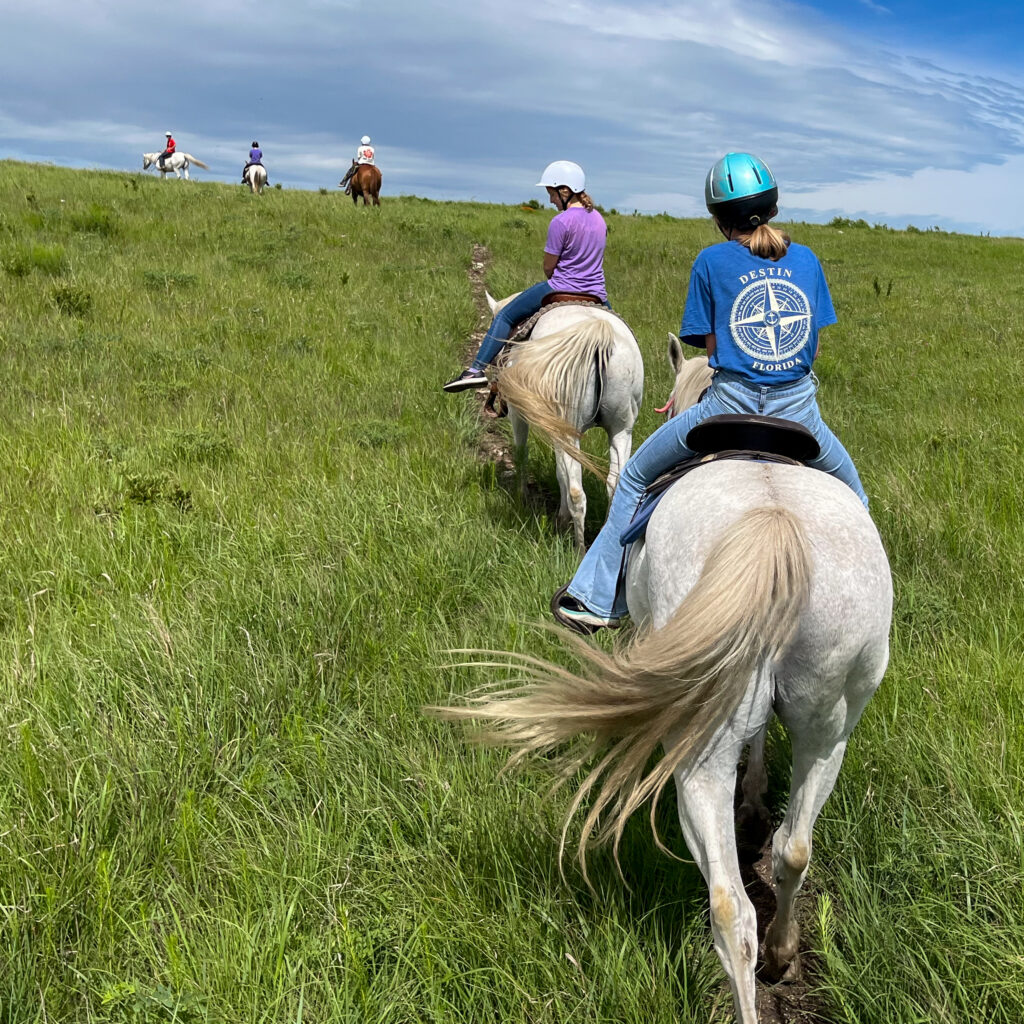
In addition to the daily rhythm of worship, communal meals, and “Y-Time” (activities ranging from horseback riding to kayaking led by YMCA staff) campers also enjoyed nightly events and celebrations. One especially beloved evening event was the camp-wide carnival. What began in 2023 as a makeshift way for the older campers to entertain the younger campers with games and activities during a bout of severe weather evolved this year into a full-scale celebration. High school and junior high cabins teamed up to create numerous carnival games and activities. Ranging from homemade mini-golf to pin-the-beak-on-the-flamingo, elementary campers competed for tickets to redeem for prizes. The carnival concluded with a particularly picturesque prairie sun- set. Campers also enjoyed participating in talent shows, dances, and “paint the counselor” – a game that is exactly what it sounds like, much to the counselor’s enjoyment.
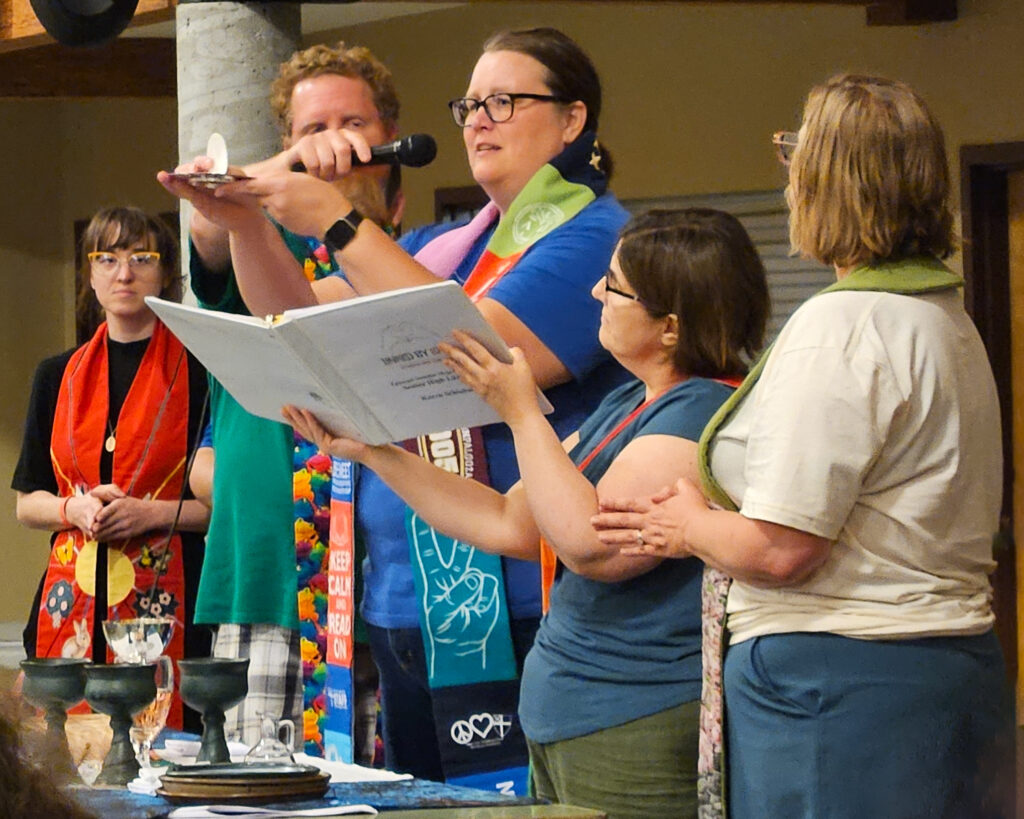
Unlike prairie grass, which every year undergoes the ancient cycle of resurrection and regrowth, prairie weather is far less predictable. This truth was particularly palpable at this year’s Mega Eucharist. Traditionally the Mega Eucharist, a camp-wide celebration of communion, is held at “High-Y,” an outdoor sanctuary with unbroken views of the surrounding prairie. This year, due to a hulking summer storm, counselors scrambled to prepare Ritchie Hall, the camp’s main dining facility, for the Eucharist.
Unfortunately, due to the severe weather, the power in Ritchie Hall went out, plunging the assembled campers and staff into semi-darkness. Undeterred, the worship went on, led by the Rev. Karen Schlabach. The sermon was delivered by senior high camper Josh McCall. Mid-way through the service, the power was restored, creating for some a Genesis-like miracle. By the conclusion of the service the storm had passed and campers returned to their cabins under a clear and twinkling prairie night sky. Such is the rhythm of this sacred part of the world, where the Spirit brings its children to remember the power and the glory of God.
Whenever a prairie is burnt it sends the land into a paradox. On one hand, the land is exhausted – the grass has given all that it can give. On the other hand, the land is restored to its most fertile – the burnt grass becomes food for the vast network of underground roots.
Prairie fire, through exhaustion, allows the plains to roar back to life, healthier and more resplendent than ever before. Camp accomplishes the same thing. At Mega Camp, campers give their all. After a week of new friends, new activities, and enriching worship, campers are often exhausted. Yet, that exhaustion leads to a profound and rejuvenated relationship with God and God’s church. It is a sign that, like the prairie grass, the camper is ready to grow into something more than before.
A previous bishop of this diocese was fond of saying that, “A week of camp does more for a child’s life of faith than a year of Sunday school.” In many ways, this is true. Camp provides the spiritual nutrients for youth to deepen their roots so they can bloom into the verdant children of God we know them to be.
by Weston Curnow
 835 SW Polk St.