by Tim Bascom
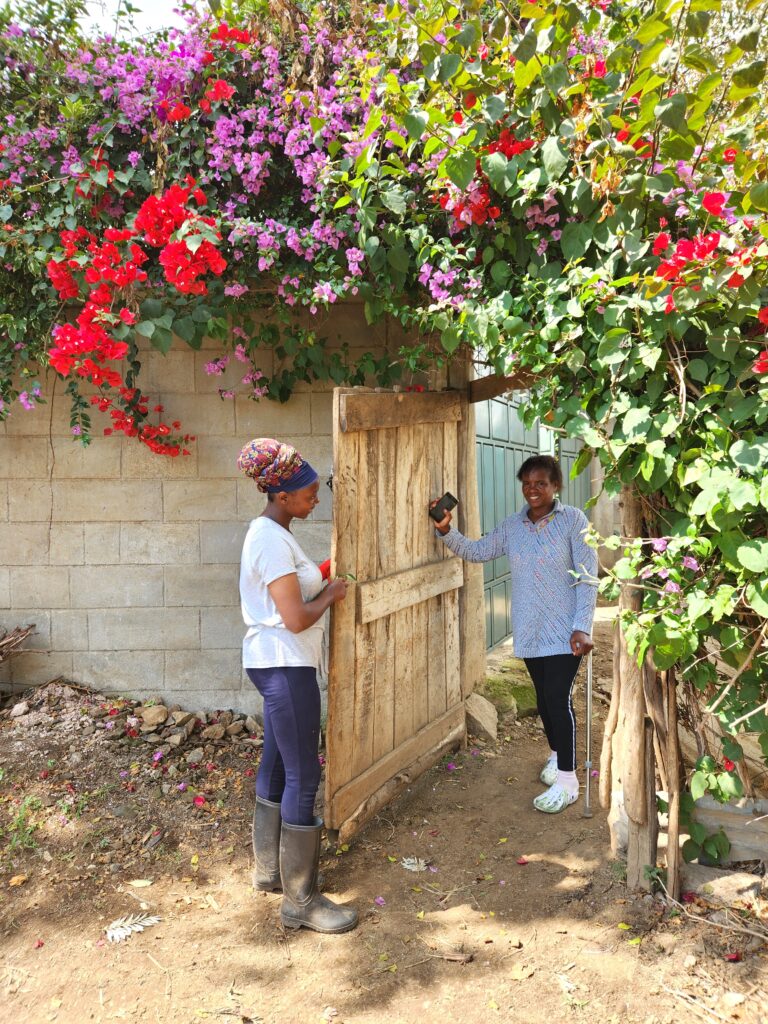
On the sloping escarpment of the Great Rift Valley, our driver eases his Toyota van up a rutted dirt road, past farm plots with rows of maize then past a long stretch of hedge blanketed by black plastic. We can’t see beyond the barrier, but bougainvillea spills over the top, and where the road ends at a metal gate, there is a thick furl of red and purple blossoms.
The driver honks, and the gate swings open. A dozen young women are lined up to greet our group of volunteers, who are part of an annual program titled K2K, meaning Kansas to Kenya.
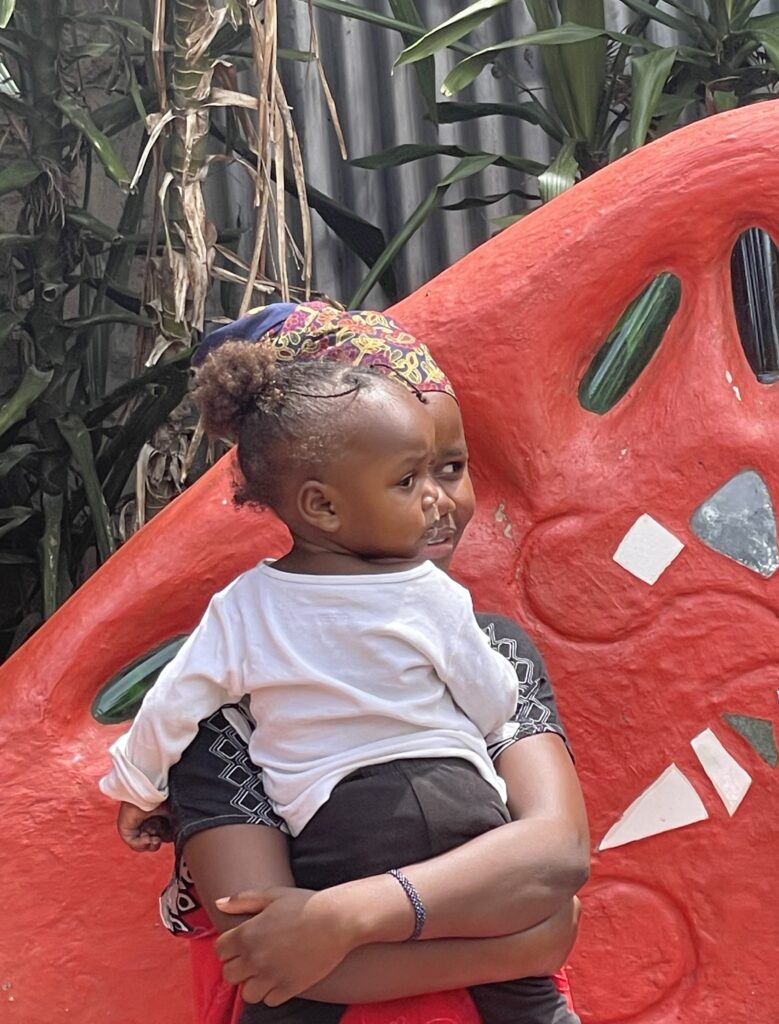
The women are dressed in red, singing in Swahili. Toddlers watch to the side, standing with caretakers who cradle babies. Behind them is a long, one-story stone building and a thatched shelter raised on stilts with clay-sand-and-straw walls that have been decorated with embedded bottles that gleam red and blue and green.
The singing women step back and forth. They sway and throw their arms. They have gleaming smiles.
No one would guess that they have been beaten or raped, or that they might be raising children they did not want. No one would guess that sometimes in the evening after the field work and the communal meal, when they are alone with those sleeping babies in the little shared rooms at the stone residence hall, they are swept by doubts, wondering if they would be better off dead.
They stop singing and come together in two rows to recite a poem written by a resident, who steps to the front confidently and leads a call-and-response.
“Never be discouraged,” she exhorts. “Don’t grow weary of doing well. Keep on doing what you know is right. Keep on walking in the light.”
And the refrain? “Never, never give up.”
This is Agatha Amani House, one of only a handful of shelters for abused women in a nation of 56 million, where domestic violence is so common that friends and family often simply ask, “What did you do to make him angry?” Out of the four or five existing shelters, this is the only one that allows women to stay for a sustained period, not just a couple of weeks. Most importantly, this is the only one that combines permaculture farming with traditional psychotherapy.
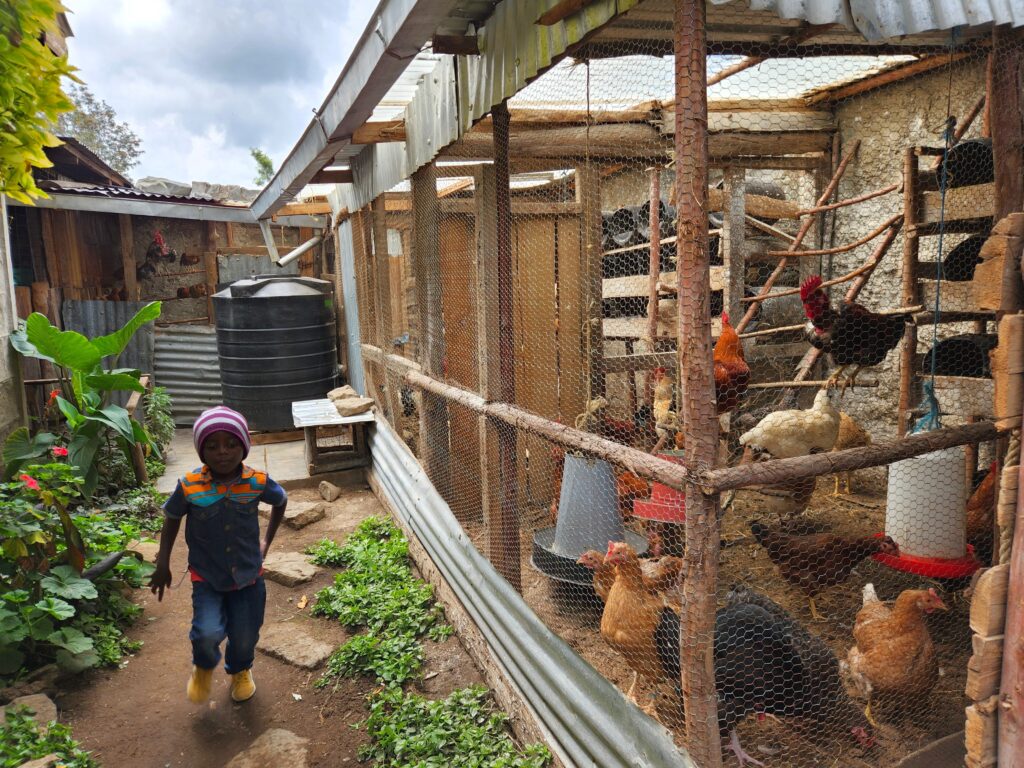
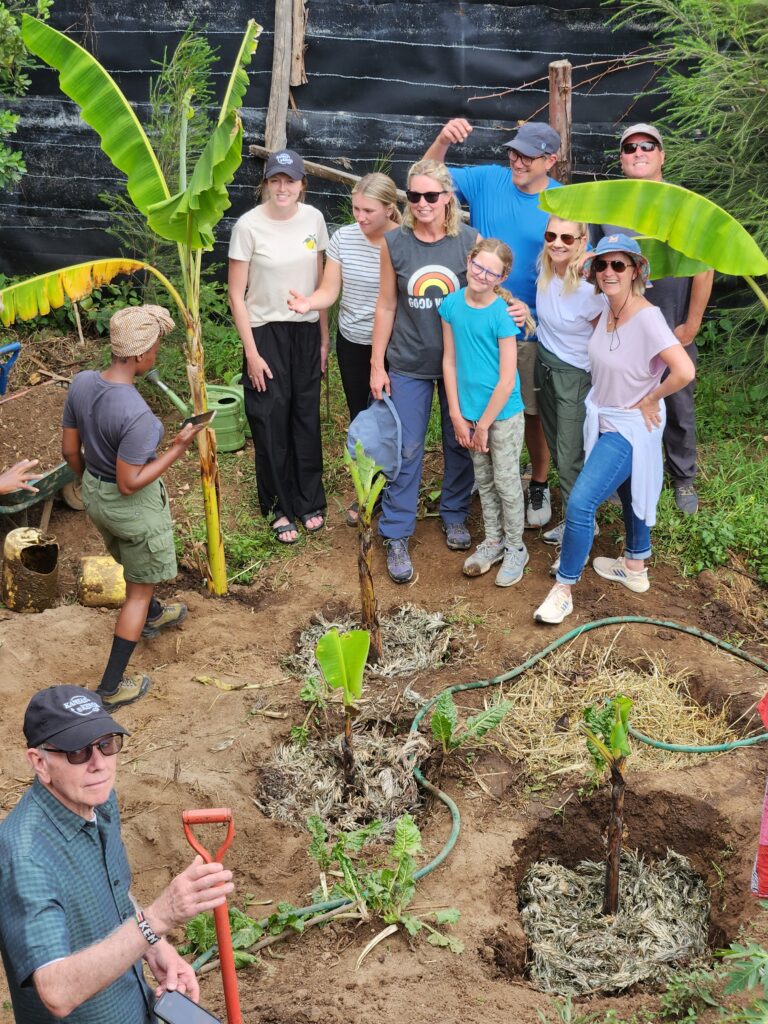
A cluster of banana trees arc away from the raised hut in the middle of the compound. Those trees have been planted in a circle, with a pit in the middle to filter soapy gray water from dish washing or bathing.
Beyond that is a raised barn with seven milk cows that sidle in and out of feeding stalls. Their manure and urine are captured and mixed in a barrel-sized concrete basin that drains into a buried cistern. Methane from that underground catchment gets piped into the kitchen for cooking, while the slurry oozes down a buried channel to a holding pit on the other side of the compound wall, where it can be used as fertilizer for several acres of carefully kept crops.
Nothing is wasted here at Agatha Amani House, which was founded by Nyakio Kaniu-Lake and named in honor of her mother, who donated the land and who had been abused by her own husband.
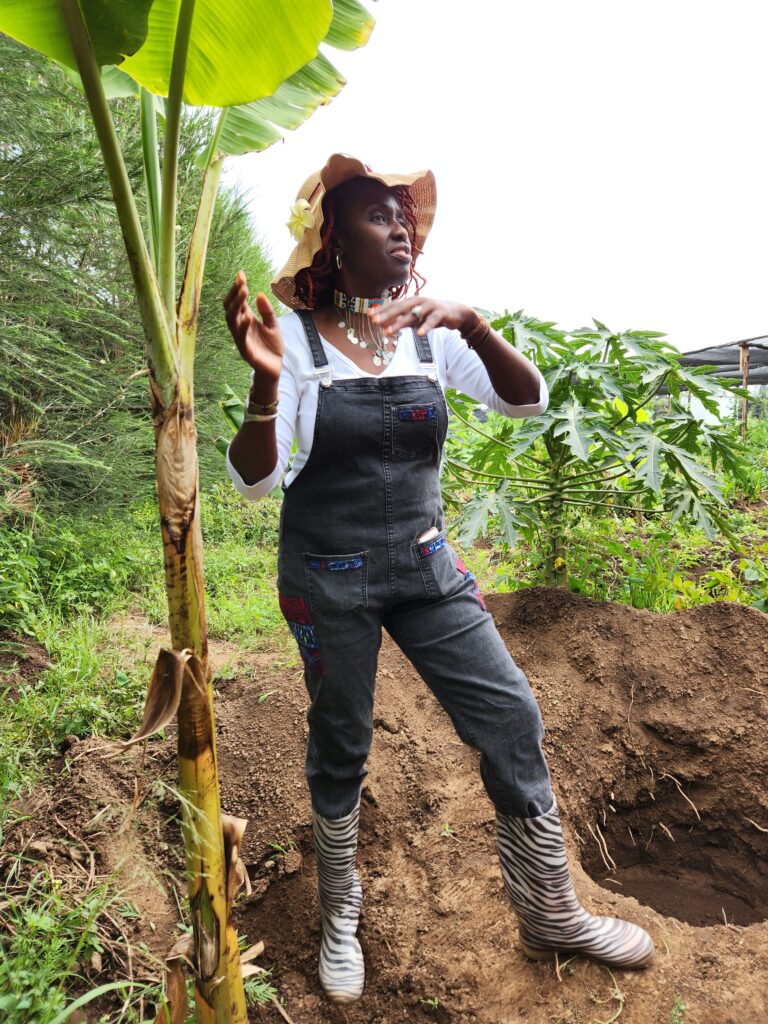
When our Kansas contingent helps a couple of residents plant a new banana circle, we pass rows of intermixed crops. The plants are combined in ways that demonstrate a natural chemical balance similar to the “three sisters” of corn, beans, and squash planted by Kansa and Wichita people before the arrival of white settlers with their soil-exhausting mono-crop farms.
The poet explains: “Spring onion and tomatoes are sisters. Also cabbage.”
Nyakio points out that the interspersed marigolds and nasturtiums will act as a natural pesticide, too.
This three-acre farm is surrounded by tall hedges to protect the residents from prying eyes. Because of the dangers these women have endured, they need complete anonymity and security, which is why we are not using names here.
One resident, for example, was only 15 when a 25-year-old man came by the rural house where she lived with her grandmother and asked for a cup of water. This was the relative of a family she knew, so she thought nothing of his request. However, when she came back from the kitchen, he had entered the house and he wrestled her to the ground then raped her.
This man threatened to kill the girl unless she stayed quiet. He said he would come back and get her if she told anyone, and so for eight excruciating months she told no one, alarmed every time she saw the perpetrator in town. She dropped out of her seventh-grade classes. Abandoned as an infant, she had no one to turn to except her grandmother, whom she didn’t want to upset. She felt utterly alone until, at last, her grandmother realized she was pregnant.
Alarmed, the girl’s grandmother reported the rape, but the rapist fled, which left the girl and her grandmother with the fear he could come back any moment and follow through on his threat to kill her — or that his angered relatives would strike out. As the birth became imminent, the grandmother finally learned about Agatha Amani House from a friend, and that is how the girl was admitted.
Her baby was born soon after arrival.
At the back of this life-saving work in Kenya is a lot of support from Kansas, and an unexpected patron: Nyakio’s husband.
Joe Bob Lake, a retired businessman from Overland Park, Kansas, was widowed in 2005. He had already met Nyakio while she was studying business at Wichita State University and about to start graduate studies in counseling at Avila University in Kansas City. Although Nyakio was much younger, when Joe Bob’s wife died, a relationship started to emerge. By 2007 they were engaged, and he traveled with her to Kenya to make it formal, marrying her there in 2009.
Joe Bob, who is a West Point graduate and served in Vietnam, narrowly escaped death in 1966, when the armored cavalry unit that he commanded was ambushed. The road was blocked by a blown-up tank, and the troops were outnumbered 10 to 1. If not for repeated tactical air strikes, they would have all perished.
As one of the survivors, he determined that, when he returned stateside, he was going to live fully, not wasting opportunities.
Still true to that principle, he married Nyakio while in sixties, and he immediately volunteered with a newly formed group of Episcopalians from St. Thomas and St. Michael churches in the Kansas City area, who would travel to Kenya annually to provide medical and community services. He has contributed substantial funding from his own pocket, and he spearheads annual fundraisers to make K2K projects possible, especially at Agatha Amani House, where new living quarters are needed.
He has also advocated increasing an important fund named Jijenge, Swahili for “build yourself up.” Through the Jijenge fund, residents are helped to transition out of Agatha Amani House. Seed capital makes small business ventures possible. Other funds pay for high school fees or technical college training, along with childcare.
Nyakio, aware of all this Kansas support, much of it prompted by her husband, says, “Without K2K, we would not even exist.”
Although volunteers now come from all over the world, including interns from China, Europe, Brazil and the U.S., Kansas support is still fundamental as Agatha Amani House expands onto adjoining land, where they plan a new natural-built residence hall and dining area, hoping to triple the number of residents in five years.
The girl mentioned earlier, an 18-year-old mother, says that when she first arrived at Agatha Amani House she could not even talk about her rape. She was sure people would judge her for not screaming. Her eyes brim but she doesn’t break down.
Instead, she states what needs to be understood: “I would have screamed, but the neighbors were too far.”
Then, in a near-whisper she admits that, after her child was born, “I could not breastfeed because of the pain still inside.”
She had not wanted to have children. She had dreamed of becoming a nun. Nevertheless, as she helped with permaculture farming and learned to bake and went through intensive counseling, she felt a shift inside her.
Her voice rises as she declares: “Agatha Amani has helped me to heal and to forgive. I will benefit when I get out. I will use these skills.”
Although she is afraid of the day she must leave, she dreams of starting a catering business and selling baby clothes as a side business. She can see a future now — after months and months of patient permaculture recovery.
 835 SW Polk St.